 by
by 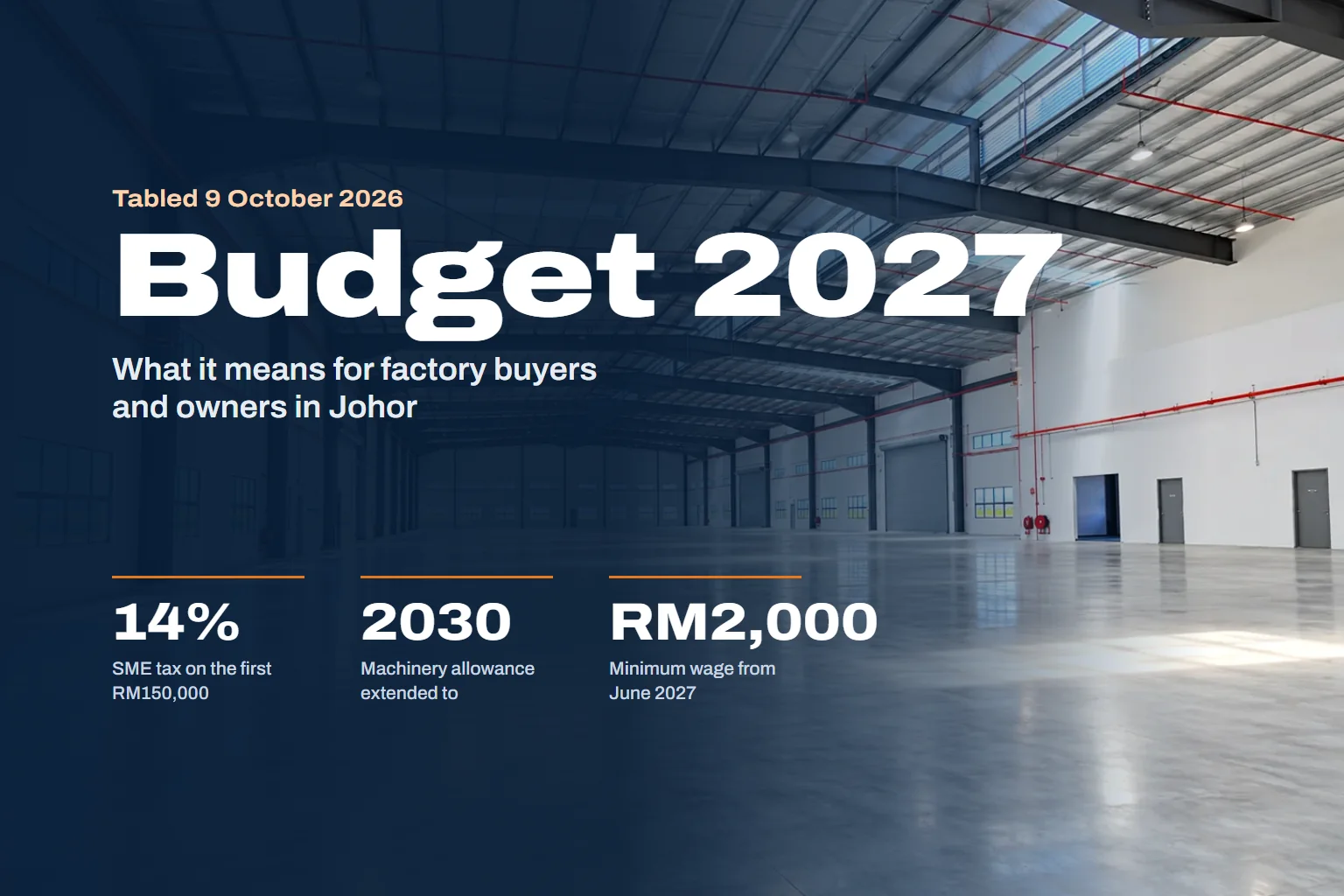
Budget 2027, tabled on 9 October 2026, does not change the rules for buying or selling a factory: there is no new stamp duty or capital gains measure for industrial property in the announced highlights. What it changes is the cost of running one. Small and medium companies pay 1% less income tax, the accelerated capital allowance on machinery is extended to the end of 2030, and the minimum wage goes up to RM2,000 from June 2027. For Johor, the budget also confirms RM132 billion of JS-SEZ investment so far and a RM12 billion target for the Sedenak industrial hub.
Here is what matters if you own a factory, plan to buy one, or rent one out in Johor. All tax measures are proposals until the Finance Bill is passed.
Budget 2027 measures that affect factory owners
| Measure | What changes | When |
|---|---|---|
| SME income tax | 14% on the first RM150,000 (was 15%), 16% on RM150,001 to RM600,000 (was 17%) | From YA 2027 |
| Accelerated capital allowance | Extended for plant, machinery and ICT equipment | Until 31 Dec 2030 |
| Small value assets | Limit per asset raised to RM3,000; non-SME total claim raised to RM30,000 | From YA 2027 |
| Green tax incentives | Investment tax allowance of up to 100% for green assets bought for own use | Until 31 Dec 2030 |
| Minimum wage | RM1,700 to RM2,000 a month; SMEs with sales below RM50 million exempt | From June 2027 |
| Business financing | Up to RM32 billion of SJPP and CGC guarantees; limit per company raised to RM50 million | From 2027 |
Sources: Malay Mail, The Star and The Edge, 9 October 2026.
Lower tax for SME factory owners
The tax cut applies to companies with paid-up capital of RM2.5 million or less and annual sales of up to RM50 million, which covers most owner-occupied factories in Johor. A company with RM600,000 of taxable profit saves RM6,000 a year: RM1,500 on the first RM150,000 and RM4,500 on the next RM450,000. Profit above RM600,000 is still taxed at 24%.
It is not a reason on its own to buy a factory, but it helps cash flow in the same year the minimum wage goes up.
Machinery, solar and the capital allowance
The accelerated capital allowance now runs to 31 December 2030, so companies have four more years to write off new machinery and ICT equipment faster. Note that it covers machinery and equipment, not the factory building. If you are buying a factory and fitting it out, the cranes, production lines and racking are where the allowance helps, so ask your tax agent how to split the spending.
The green investment tax allowance of up to 100% is also extended to the end of 2030. For a factory owner, the most common use is rooftop solar. A detached factory with a large, strong roof is worth more to buyers who want to cut their electricity bill, so check the roof structure and the TNB connection when you view a property.
RM2,000 minimum wage from June 2027
Larger manufacturers must pay at least RM2,000 a month from June 2027. SMEs with sales below RM50 million are exempt for now; the government has not said for how long. For labour-heavy factories, the higher wage pushes more spending into automation, which in turn needs more power, higher ceilings and stronger floors. If you are choosing a factory now, pick one with room to grow on these points rather than the cheapest unit that fits today’s setup.
What the budget says about Johor
- JS-SEZ: RM132 billion of investments recorded from 2025 to June 2026. The JS-SEZ master plan and blueprint will be launched by the prime ministers of Malaysia and Singapore by the end of 2026. Our JS-SEZ guide explains the incentives and the nine flagship areas.
- Sedenak industrial hub: a target of RM12 billion of investment and 45,000 jobs. Sedenak and nearby Kulai are where most new data centre and manufacturing land is being sold; see our Sedenak article and the factories in Kulai.
- Johor Bahru traffic: the government chose the elevated autonomous rapid transit (e-ART) as the main fix, plus more bus routes, KTM Komuter trips and Grab shuttles before the RTS Link opens in February 2027 (Malay Mail).
- Power: TNB will invest RM15 billion to strengthen the national grid, and UEM Lestra plans a 1 GW hybrid energy project in Johor. Power supply is the main limit for new data centres and large factories in the state.
- Global Services Hub: from 1 January 2027, the 5% concessionary rate can be extended for up to 30 years. This is for regional head offices and service companies, not manufacturing.
What it means if you buy, rent or own a factory
- Buyers: purchase costs do not change. Stamp duty, legal fees and, for foreign buyers, state consent work the same way as before; our guide to buying a factory in Johor covers the steps. The financing guarantees (up to RM50 million per company) may help SMEs that need a larger loan for a purchase plus machinery.
- Tenants: rent is still a deductible business expense. The lower SME tax and the extended capital allowance favour spending on machines rather than on the building, which keeps renting attractive for companies that are still growing. Factory rents in Johor are around RM2.50 per sq ft a month in October 2026.
- Landlords and investors: demand from JS-SEZ and Sedenak projects supports rents in Kulai, Senai and Iskandar Puteri. Factories with high power, good ceiling height and room for solar will be easier to let. Our investment guide shows how to work out the yield.
What to watch next
Three dates matter for Johor industrial property: the Finance Bill, which turns these proposals into law; the JS-SEZ master plan at the end of 2026, which should show which areas get priority; and the RTS Link opening in February 2027. We will update our Johor industrial outlook and land price guide as they happen.
👉 Looking for a factory in Kulai, Senai or elsewhere in Johor? Browse factories for sale and factories for rent, or WhatsApp Jimmy with your size, area and budget.